


Quick answer: Burnout-related symptoms overlap with other medical and mental-health conditions; careful differentiation matters.
Health information: This article is educational, not a diagnosis or medical recommendation. Individual risks vary; ask a qualified clinician about symptoms, treatment and contraindications.
This guide addresses burnout physical symptoms from the perspective of a reader who needs a decision, not just a definition. It sets out four criteria, an example, a simple self-assessment and the sources worth reviewing. The decision framework is editorial guidance; it is not a proprietary benchmark or a substitute for professional judgment.
The essentials: what really matters
Health and recovery questions involve meaningful variation between people. Training history, medical conditions, medications, sleep patterns and the outcome being measured can all change what a sensible approach looks like. One anecdote or a single small trial cannot establish a general treatment recommendation.
At a glance
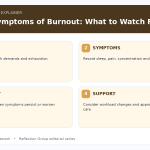
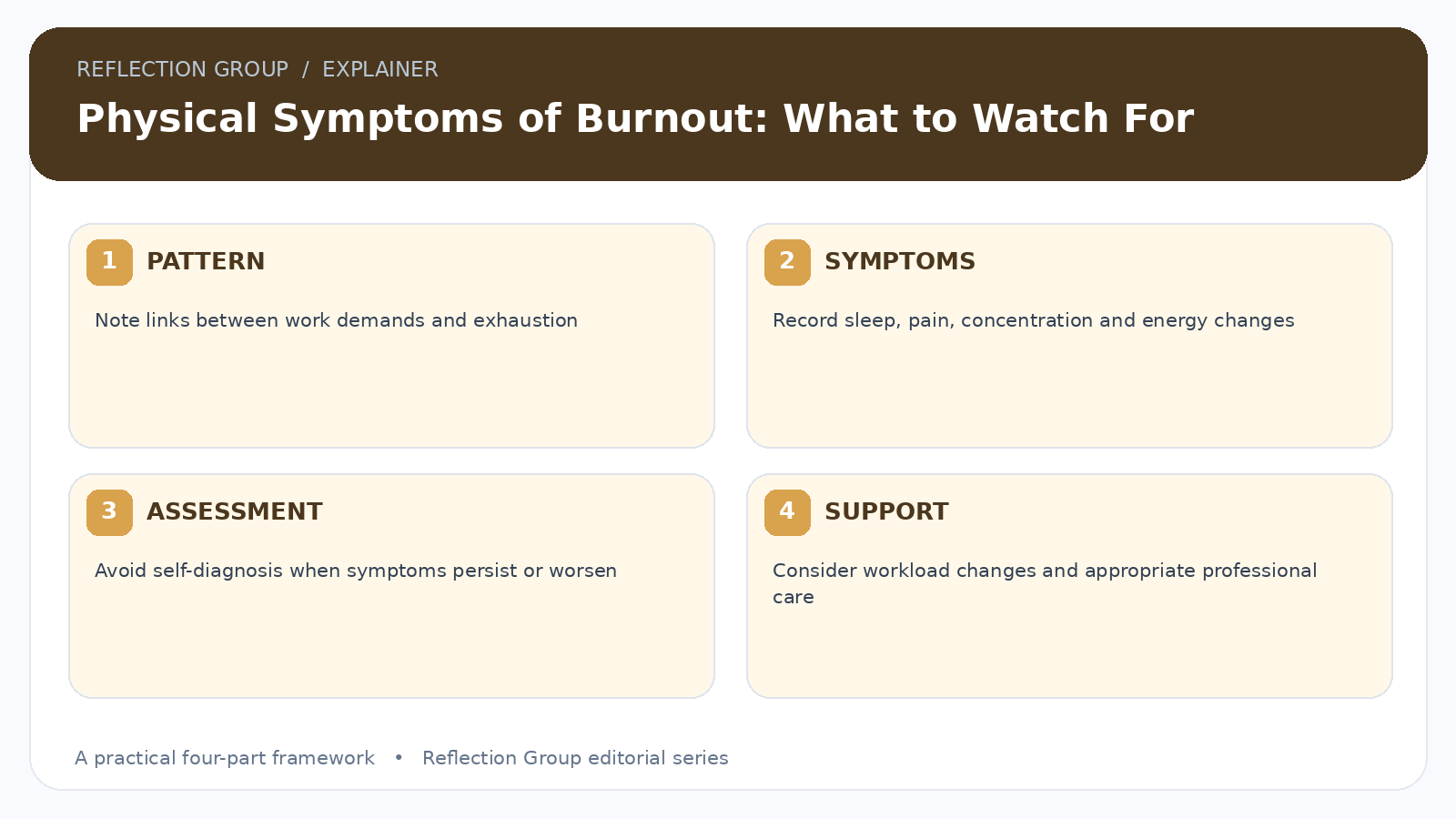
- Pattern: Note links between work demands and exhaustion
- Symptoms: Record sleep, pain, concentration and energy changes
- Assessment: Avoid self-diagnosis when symptoms persist or worsen
- Support: Consider workload changes and appropriate professional care
Persistent fatigue can have multiple contributors, including sleep patterns; the limits of catch-up sleep are discussed in sleep debt research.
The four-part evaluation framework
1. Pattern
Note links between work demands and exhaustion. The first practical action is to request one concrete example relevant to your own situation. Ask who produced it, when it was checked and what would make it invalid. Do not accept a broad assurance where a record, document, calculation or observed process can settle the question more reliably.
For burnout physical symptoms, define an evidence standard for pattern. A useful record identifies the owner, the supporting source and any open exception. If the information is missing, mark the criterion as unverified rather than assuming success. This distinction helps prevent a polished presentation from being mistaken for a tested outcome.
2. Symptoms
Record sleep, pain, concentration and energy changes. The first practical action is to request one concrete example relevant to your own situation. Ask who produced it, when it was checked and what would make it invalid. Do not accept a broad assurance where a record, document, calculation or observed process can settle the question more reliably.
For burnout physical symptoms, define an evidence standard for symptoms. A useful record identifies the owner, the supporting source and any open exception. If the information is missing, mark the criterion as unverified rather than assuming success. This distinction helps prevent a polished presentation from being mistaken for a tested outcome.
3. Assessment
Avoid self-diagnosis when symptoms persist or worsen. The first practical action is to request one concrete example relevant to your own situation. Ask who produced it, when it was checked and what would make it invalid. Do not accept a broad assurance where a record, document, calculation or observed process can settle the question more reliably.
For burnout physical symptoms, define an evidence standard for assessment. A useful record identifies the owner, the supporting source and any open exception. If the information is missing, mark the criterion as unverified rather than assuming success. This distinction helps prevent a polished presentation from being mistaken for a tested outcome.
4. Support
Consider workload changes and appropriate professional care. The first practical action is to request one concrete example relevant to your own situation. Ask who produced it, when it was checked and what would make it invalid. Do not accept a broad assurance where a record, document, calculation or observed process can settle the question more reliably.
For burnout physical symptoms, define an evidence standard for support. A useful record identifies the owner, the supporting source and any open exception. If the information is missing, mark the criterion as unverified rather than assuming success. This distinction helps prevent a polished presentation from being mistaken for a tested outcome.
An efficiency measurement is not a medical diagnosis; see sleep efficiency guide for its proper interpretation.
For a complementary earlier perspective, read the meditation and stress-management overview.
One-page comparison table
| Criterion | Evidence to request | Decision signal |
|---|---|---|
| Pattern | Study method or personal observation log | Note links between work demands and exhaustion |
| Symptoms | Study method or personal observation log | Record sleep, pain, concentration and energy changes |
| Assessment | Study method or personal observation log | Avoid self-diagnosis when symptoms persist or worsen |
| Support | Study method or personal observation log | Consider workload changes and appropriate professional care |
Illustrated decision framework

Original Reflection Group diagram. The four stages are a practical editorial framework, not a certification or clinical scoring standard.
Interactive decision helper
Use the tool below to organize your own situation. Its output is illustrative and is deliberately not presented as legal, health or financial advice. A low score means more verification is needed, not that the option is automatically wrong.
Four-point decision scorecard
Check each area only after you have evidence relevant to your situation:
0 of 4 criteria verified
Editorial organization aid only; not a professional certification or risk score.Example: applying the framework
A professional with persistent exhaustion books an assessment instead of assuming every symptom is burnout.
When reading research, identify who was studied, what intervention was tested, which outcomes were measured and how confident the authors were. An improvement in comfort or mood does not automatically imply improved performance, reduced injury or treatment of a medical condition.
In that example, the next step is to record which of the four criteria has persuasive evidence and which remains uncertain. That creates an actionable follow-up: obtain a missing record, change the scope, negotiate responsibility or seek a specialist assessment. It is more useful than declaring a universally best product or method.
Common mistake — and how to avoid it
Do not treat chest pain, severe symptoms or major mood changes as harmless stress. Treat any proposal or article as a starting hypothesis. Confirm the underlying conditions before transferring its conclusion to a different organization, country, health profile or bottle.
Record personal patterns with context rather than chasing a single number. Persistent symptoms, sudden deterioration or symptoms that might require urgent assessment should be addressed by a healthcare professional, not a web calculator. The examples here are educational, not individualized medical advice.
Next steps: a practical checklist
- Write down the particular decision behind your search for burnout physical symptoms.
- Check pattern with documented evidence, not an assumption.
- Check symptoms with documented evidence, not an assumption.
- Check assessment with documented evidence, not an assumption.
- Check support with documented evidence, not an assumption.
- Compare at least two realistic alternatives using the same evaluation conditions.
- Capture outstanding uncertainties and schedule a review before making an irreversible decision.
Frequently asked questions
What physical symptoms can accompany burnout?
People may report fatigue, disturbed sleep, headaches, muscle tension or gastrointestinal complaints, but these are nonspecific and can have other medical explanations.
When is medical assessment warranted?
Seek professional evaluation for persistent or worsening symptoms, changes in functioning or concerns about another illness. Urgent symptoms require timely medical care rather than self-diagnosis from an online article.
Reliable references and further reading
These primary or specialist sources provide context for checking the relevant concepts. Their existence does not mean they endorse this article or its editorial scoring framework.
- CDC sleep duration and sleep health
- CDC adult sleep facts