




Quick answer: The best agent use cases are repetitive, observable and reversible, with clear ownership of exceptions.
This guide addresses ai agents for business operations from the perspective of a reader who needs a decision, not just a definition. It sets out four criteria, an example, a simple self-assessment and the sources worth reviewing. The decision framework is editorial guidance; it is not a proprietary benchmark or a substitute for professional judgment.
The essentials: what really matters
The relevant unit of analysis is a repeatable task with observable inputs and outputs. Before evaluating vendors or approaches, write down which decision a person is trying to make, what evidence that decision requires and which risks the system must not introduce. A confident-sounding answer without provenance is a failure for many business use cases.
At a glance
- Workflow fit: Prefer bounded tasks with structured inputs and clear success criteria
- Economic case: Compare review time, error cost and process throughput
- Controls: Separate research-only tasks from transactions and irreversible actions
- Rollout: Pilot with human review before increasing autonomy
Every proposed workflow needs a security boundary; the risks are detailed in AI agent security risks.
The four-part evaluation framework
1. Workflow fit
Prefer bounded tasks with structured inputs and clear success criteria. The first practical action is to request one concrete example relevant to your own situation. Ask who produced it, when it was checked and what would make it invalid. Do not accept a broad assurance where a record, document, calculation or observed process can settle the question more reliably.
For ai agents for business operations, define an evidence standard for workflow fit. A useful record identifies the owner, the supporting source and any open exception. If the information is missing, mark the criterion as unverified rather than assuming success. This distinction helps prevent a polished presentation from being mistaken for a tested outcome.
2. Economic case
Compare review time, error cost and process throughput. The first practical action is to request one concrete example relevant to your own situation. Ask who produced it, when it was checked and what would make it invalid. Do not accept a broad assurance where a record, document, calculation or observed process can settle the question more reliably.
For ai agents for business operations, define an evidence standard for economic case. A useful record identifies the owner, the supporting source and any open exception. If the information is missing, mark the criterion as unverified rather than assuming success. This distinction helps prevent a polished presentation from being mistaken for a tested outcome.
3. Controls
Separate research-only tasks from transactions and irreversible actions. The first practical action is to request one concrete example relevant to your own situation. Ask who produced it, when it was checked and what would make it invalid. Do not accept a broad assurance where a record, document, calculation or observed process can settle the question more reliably.
For ai agents for business operations, define an evidence standard for controls. A useful record identifies the owner, the supporting source and any open exception. If the information is missing, mark the criterion as unverified rather than assuming success. This distinction helps prevent a polished presentation from being mistaken for a tested outcome.
4. Rollout
Pilot with human review before increasing autonomy. The first practical action is to request one concrete example relevant to your own situation. Ask who produced it, when it was checked and what would make it invalid. Do not accept a broad assurance where a record, document, calculation or observed process can settle the question more reliably.
For ai agents for business operations, define an evidence standard for rollout. A useful record identifies the owner, the supporting source and any open exception. If the information is missing, mark the criterion as unverified rather than assuming success. This distinction helps prevent a polished presentation from being mistaken for a tested outcome.
Choose frameworks against deployment constraints rather than demos; use agentic AI framework selection for a structured comparison.
For a complementary earlier perspective, read the guide to selecting an AI automation agency.
One-page comparison table
| Criterion | Evidence to request | Decision signal |
|---|---|---|
| Workflow fit | Sample output or trace | Prefer bounded tasks with structured inputs and clear success criteria |
| Economic case | Sample output or trace | Compare review time, error cost and process throughput |
| Controls | Sample output or trace | Separate research-only tasks from transactions and irreversible actions |
| Rollout | Sample output or trace | Pilot with human review before increasing autonomy |
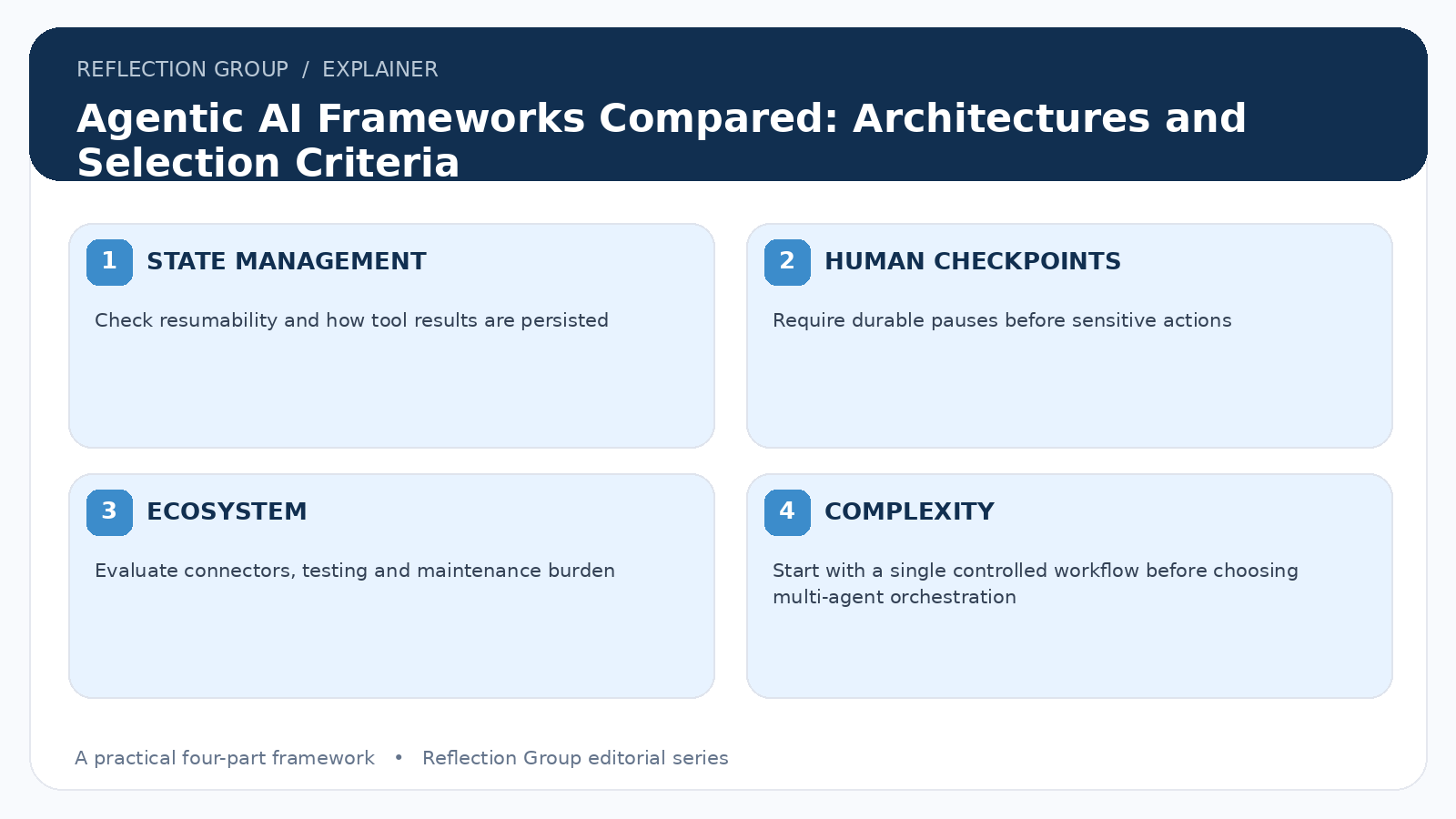
Illustrated decision framework

Original Reflection Group diagram. The four stages are a practical editorial framework, not a certification or clinical scoring standard.
Interactive decision helper
Use the tool below to organize your own situation. Its output is illustrative and is deliberately not presented as legal, health or financial advice. A low score means more verification is needed, not that the option is automatically wrong.
Four-point decision scorecard
Check each area only after you have evidence relevant to your situation:
0 of 4 criteria verified
Editorial organization aid only; not a professional certification or risk score.Example: applying the framework
An agent drafts invoice coding recommendations for a human accountant instead of posting uncertain transactions automatically.
A meaningful comparison uses the same dataset, questions and review rubric for every option. Document model versions, timestamps and test conditions. Track exceptions, because an average score may conceal costly edge cases, privacy failures or downstream actions the reviewer would not approve.
In that example, the next step is to record which of the four criteria has persuasive evidence and which remains uncertain. That creates an actionable follow-up: obtain a missing record, change the scope, negotiate responsibility or seek a specialist assessment. It is more useful than declaring a universally best product or method.
Common mistake — and how to avoid it
Avoid automating a broken process simply because an LLM can imitate it. Treat any proposal or article as a starting hypothesis. Confirm the underlying conditions before transferring its conclusion to a different organization, country, health profile or bottle.
Start with a small baseline, collect examples of failure, then change one factor at a time. Human review is useful where stakes are material, but only if reviewers have clear criteria and enough information to challenge an output. Governance is a process with a named owner, not a one-time launch meeting.
Next steps: a practical checklist
- Write down the particular decision behind your search for ai agents for business operations.
- Check workflow fit with documented evidence, not an assumption.
- Check economic case with documented evidence, not an assumption.
- Check controls with documented evidence, not an assumption.
- Check rollout with documented evidence, not an assumption.
- Compare at least two realistic alternatives using the same evaluation conditions.
- Capture outstanding uncertainties and schedule a review before making an irreversible decision.
Frequently asked questions
Which business workflows are good first candidates for an AI agent?
Start with bounded, reversible work such as intake classification, draft preparation and internal reporting. Define expected inputs, outputs, exception paths and human review before automating a customer-facing process.
How should ROI be calculated?
Compare time saved and error rates against integration cost, quality assurance, human oversight and failure recovery. Measure full workflow outcomes, not only how quickly the model creates a draft.
Reliable references and further reading
These primary or specialist sources provide context for checking the relevant concepts. Their existence does not mean they endorse this article or its editorial scoring framework.
- NIST AI Risk Management Framework
- NIST Generative AI Profile