




Quick answer: Article 28 GDPR requires contractual safeguards when a processor handles personal data on behalf of a controller.
Important: General educational information only. It is not legal, tax or regulatory advice. Verify jurisdiction-specific requirements with a qualified professional and the competent authority.
This guide addresses when is a data processing agreement required from the perspective of a reader who needs a decision, not just a definition. It sets out four criteria, an example, a simple self-assessment and the sources worth reviewing. The decision framework is editorial guidance; it is not a proprietary benchmark or a substitute for professional judgment.
The essentials: what really matters
Legal and regulatory outcomes depend on the precise facts and jurisdiction. Start by identifying the parties, activity, applicable rules and date. A general definition is useful orientation, but a threshold or filing requirement from another country may be misleading in your own case.
At a glance
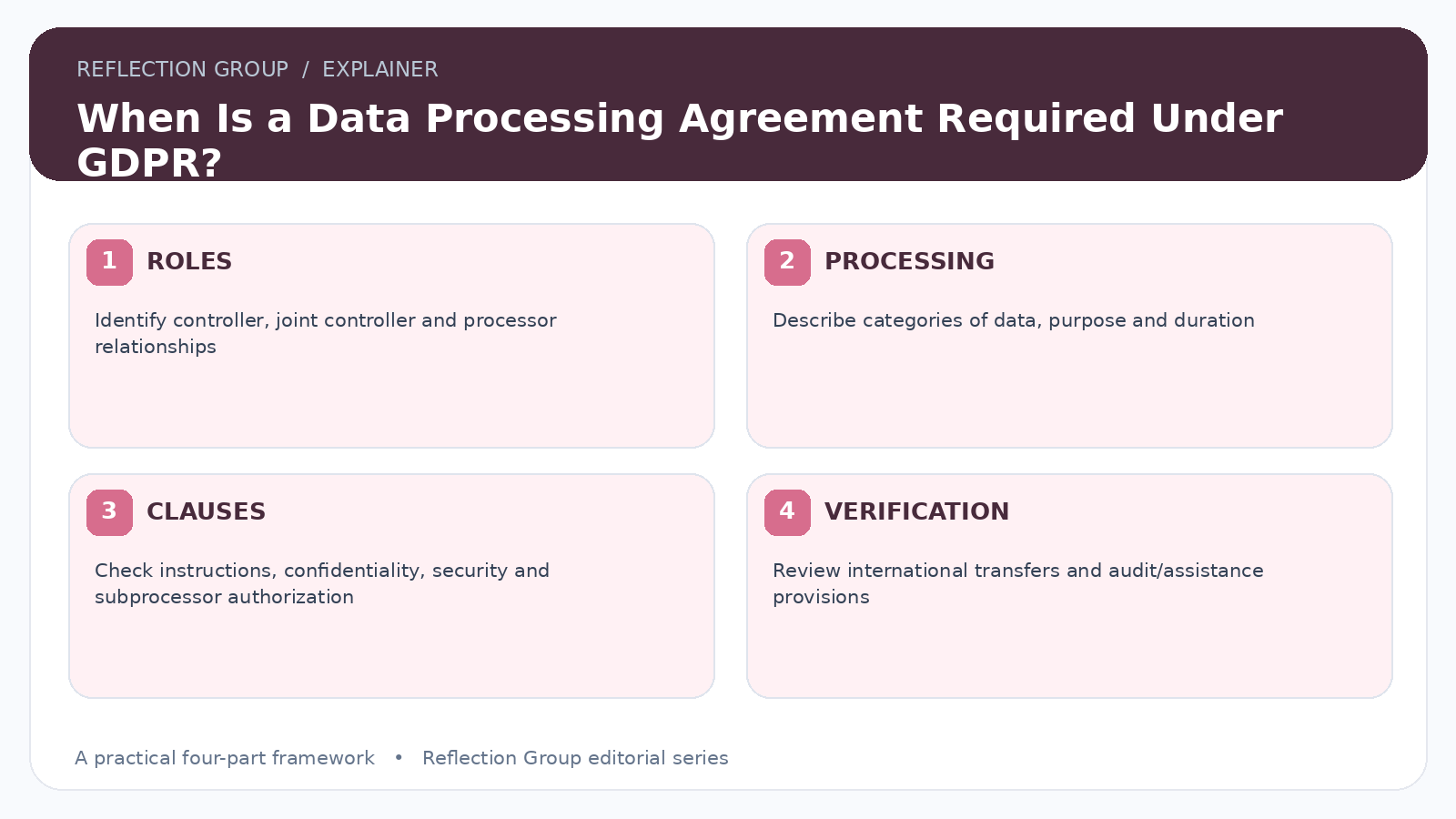
- Roles: Identify controller, joint controller and processor relationships
- Processing: Describe categories of data, purpose and duration
- Clauses: Check instructions, confidentiality, security and subprocessor authorization
- Verification: Review international transfers and audit/assistance provisions
AI systems that process personal data need separate governance controls; consult EU AI Act compliance.
The four-part evaluation framework
1. Roles
Identify controller, joint controller and processor relationships. The first practical action is to request one concrete example relevant to your own situation. Ask who produced it, when it was checked and what would make it invalid. Do not accept a broad assurance where a record, document, calculation or observed process can settle the question more reliably.
For when is a data processing agreement required, define an evidence standard for roles. A useful record identifies the owner, the supporting source and any open exception. If the information is missing, mark the criterion as unverified rather than assuming success. This distinction helps prevent a polished presentation from being mistaken for a tested outcome.
2. Processing
Describe categories of data, purpose and duration. The first practical action is to request one concrete example relevant to your own situation. Ask who produced it, when it was checked and what would make it invalid. Do not accept a broad assurance where a record, document, calculation or observed process can settle the question more reliably.
For when is a data processing agreement required, define an evidence standard for processing. A useful record identifies the owner, the supporting source and any open exception. If the information is missing, mark the criterion as unverified rather than assuming success. This distinction helps prevent a polished presentation from being mistaken for a tested outcome.
3. Clauses
Check instructions, confidentiality, security and subprocessor authorization. The first practical action is to request one concrete example relevant to your own situation. Ask who produced it, when it was checked and what would make it invalid. Do not accept a broad assurance where a record, document, calculation or observed process can settle the question more reliably.
For when is a data processing agreement required, define an evidence standard for clauses. A useful record identifies the owner, the supporting source and any open exception. If the information is missing, mark the criterion as unverified rather than assuming success. This distinction helps prevent a polished presentation from being mistaken for a tested outcome.
4. Verification
Review international transfers and audit/assistance provisions. The first practical action is to request one concrete example relevant to your own situation. Ask who produced it, when it was checked and what would make it invalid. Do not accept a broad assurance where a record, document, calculation or observed process can settle the question more reliably.
For when is a data processing agreement required, define an evidence standard for verification. A useful record identifies the owner, the supporting source and any open exception. If the information is missing, mark the criterion as unverified rather than assuming success. This distinction helps prevent a polished presentation from being mistaken for a tested outcome.
Audit readiness may also demand independent access and data handling controls described in SOC 2 compliance checklist.
One-page comparison table
| Criterion | Evidence to request | Decision signal |
|---|---|---|
| Roles | Official document and legal basis | Identify controller, joint controller and processor relationships |
| Processing | Official document and legal basis | Describe categories of data, purpose and duration |
| Clauses | Official document and legal basis | Check instructions, confidentiality, security and subprocessor authorization |
| Verification | Official document and legal basis | Review international transfers and audit/assistance provisions |
Illustrated decision framework
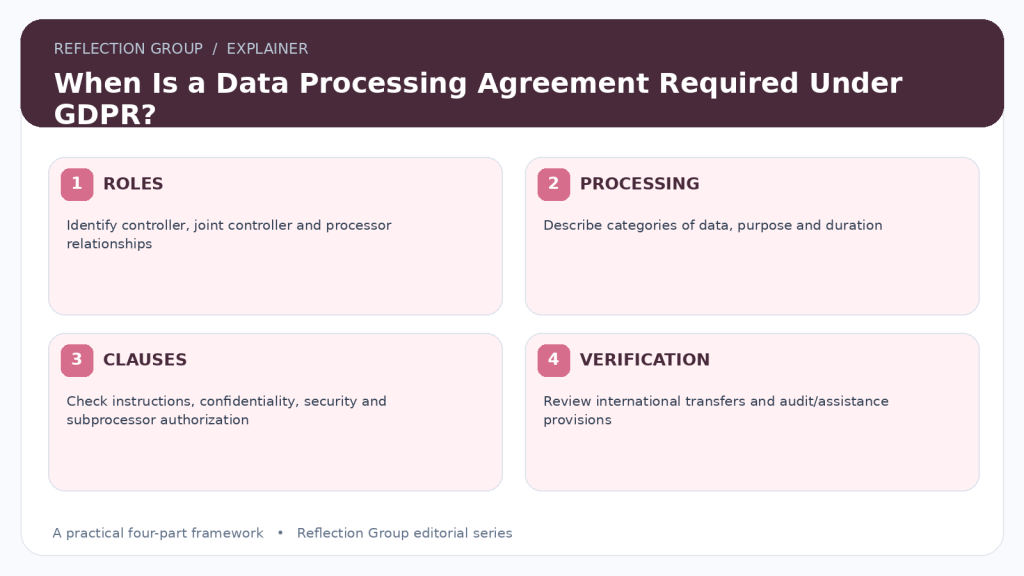
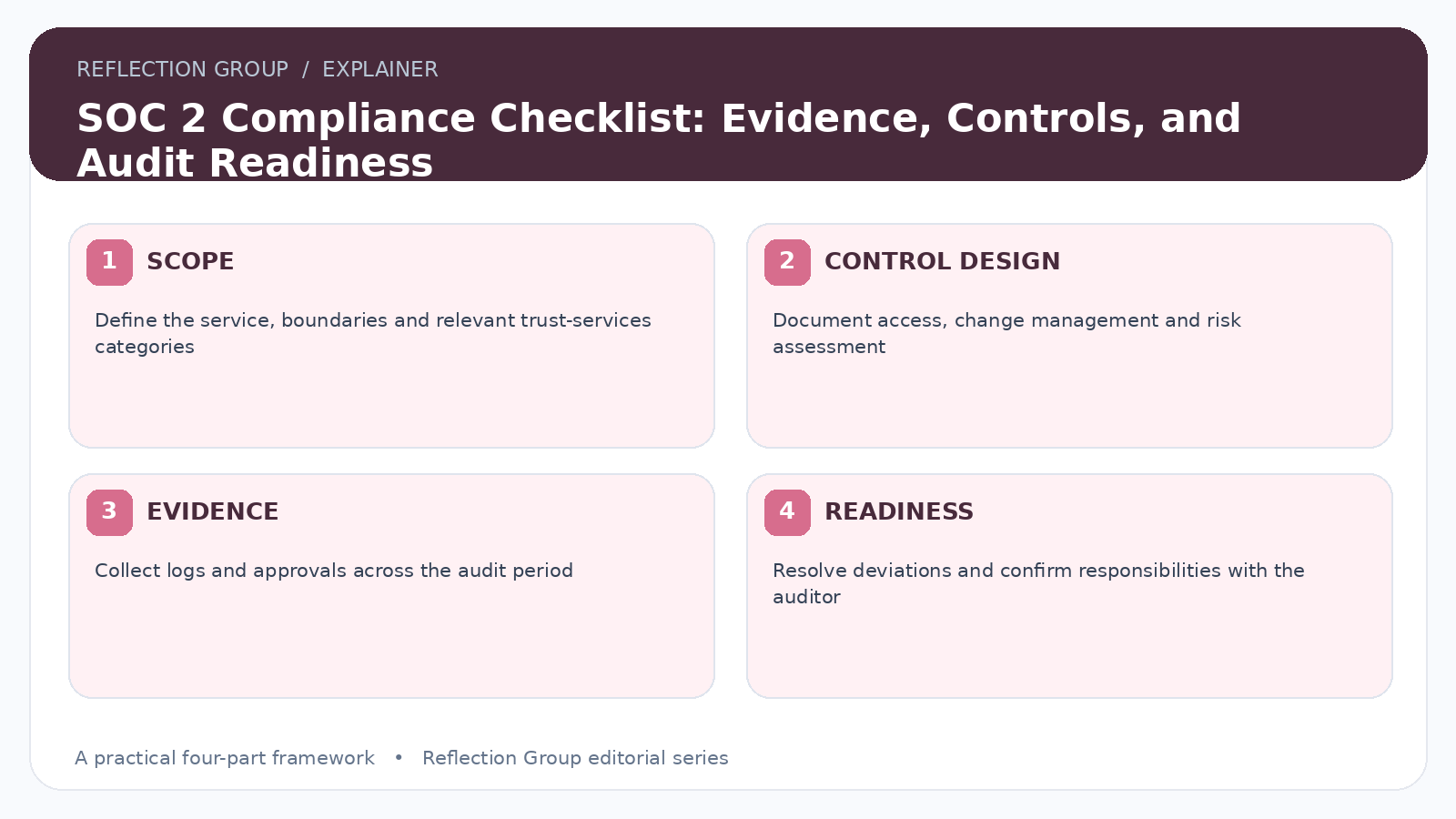
Original Reflection Group diagram. The four stages are a practical editorial framework, not a certification or clinical scoring standard.
Interactive decision helper
Use the tool below to organize your own situation. Its output is illustrative and is deliberately not presented as legal, health or financial advice. A low score means more verification is needed, not that the option is automatically wrong.
Four-point decision scorecard
Check each area only after you have evidence relevant to your situation:
0 of 4 criteria verified
Editorial organization aid only; not a professional certification or risk score.Example: applying the framework
A payroll vendor processes employee information under client instructions; the parties assess the Article 28 agreement.
Build an evidence register rather than a simple list of yes/no answers. Keep documents, control owners, outstanding issues and a review date. When roles or business activities change, revisit the analysis rather than assuming the original assessment remains correct.
In that example, the next step is to record which of the four criteria has persuasive evidence and which remains uncertain. That creates an actionable follow-up: obtain a missing record, change the scope, negotiate responsibility or seek a specialist assessment. It is more useful than declaring a universally best product or method.
Common mistake — and how to avoid it
Calling a contract an NDA does not make it an adequate processing agreement. Treat any proposal or article as a starting hypothesis. Confirm the underlying conditions before transferring its conclusion to a different organization, country, health profile or bottle.
Use primary regulatory material wherever possible and distinguish binding rules from industry good practice. Where penalties, tax liabilities, financial crime or individual rights could be affected, the practical step is to obtain a qualified local review before acting.
Next steps: a practical checklist
- Write down the particular decision behind your search for when is a data processing agreement required.
- Check roles with documented evidence, not an assumption.
- Check processing with documented evidence, not an assumption.
- Check clauses with documented evidence, not an assumption.
- Check verification with documented evidence, not an assumption.
- Compare at least two realistic alternatives using the same evaluation conditions.
- Capture outstanding uncertainties and schedule a review before making an irreversible decision.
Frequently asked questions
When is a GDPR data processing agreement required?
Article 28 of the GDPR generally requires a contract or other legal act when a processor handles personal data on behalf of a controller. Whether parties are controllers or processors depends on their actual roles.
Which clauses should a processor agreement cover?
Core elements include processing instructions, confidentiality, security, subprocessor conditions, assistance, deletion or return of data and audit rights. International transfer mechanisms may require separate assessment.
Reliable references and further reading
These primary or specialist sources provide context for checking the relevant concepts. Their existence does not mean they endorse this article or its editorial scoring framework.
- GDPR full Regulation, Article 28